Home / Foot care / Standing desk feet
Sit · stand · walk · fidget
Standing desk feet that don’t hate you
The trick isn’t standing all day. It’s not staying in any one position too long. Sit, stand, walk, fidget, repeat. Habits first, gear second. Not a diagnosis. Not medical advice.
- Your best posture is your next one. Change it often.
- Every 30–60 min: switch sit ↔ stand, or walk 2–5 minutes.
- Keep your feet busy under the desk: shift weight, lift toes, roll a ball.
- Wide, flexible shoes (or socks on a mat) beat stiff, narrow ones on long days.
- Gear is optional. Start free, then add one tool at a time.
Who this helps
- Sit/stand desk owners whose feet are done by 3 pm
- Fence-sitters deciding between a converter, a Cubii, or a walking pad
- Anyone who wants under-desk fidget tools that don’t look like a home gym
- Mostly-seated desk workers who want to build toward a big daily step goal without leaving the desk
Need a diagnosis or rehab plan? That’s a clinician, not this page.
Sit, stand, walk: desk culture, not a rule
Sit when you’re deep in focused work. Feet flat, or on a footrest, and move them now and then.
Stand for calls, quick email, and the post-lunch slump. Soft knees, weight moving around. Standing still for hours is just sitting vertically.
Walk for easy calls, reading, and thinking: a hallway lap, a walk around the block, or a walking pad at low speed.
No magic ratio. Pick a rhythm you’ll actually keep and let a calendar reminder or a refill of your water bottle nudge the switch.
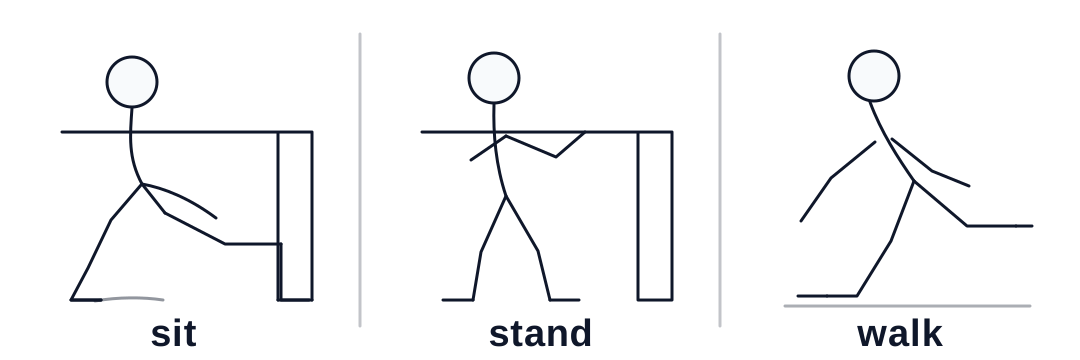
Sit / stand / walk on a rhythm you can keep — habits first.
A long workday, one way
- Before work (5 min): a day from the foot-forward warm-up. Toes and ankles awake before the desk.
- Morning block: sit for deep work. Stand for the first call.
- Mid-morning: 2–5 minute walk. Kitchen, stairs, mailbox.
- Lunch: get outside, even for 10 minutes.
- Afternoon slump: stand or walk-pad for 10–20 minutes at an easy pace.
- Late afternoon: sit, and keep the feet busy with a roller or footrest.
- End of day: a short seated roll if it feels good. Shoes off.
A sample rhythm, not a prescription. Shrink it, stretch it, skip what doesn’t fit.
Free desk-side moves (no gear)
- Heel ↔ forefoot shifts: rock slowly while standing, 30 seconds.
- Toe lifts: big toe up, then little toes up. Seated or standing.
- Toe spreads: spread the toes against the floor, hold 3 seconds, a few times.
- Slow calf raises: 5–8, hand on the desk.
- One-leg stand: 20 seconds a side while a page loads, fingertips on the desk.
- Walk-and-talk: take any call that doesn’t need a screen on your feet.
Stop if anything feels sharp or wrong. These are movement snacks, not treatment.
Floor and shoes
- Shoes: roomy toe box, flexible sole, low or zero drop when dress code allows. See the shoe hub.
- Barefoot or socks at a home desk: fine for many people on a mat or carpet. Switch to shoes if your feet get sore on hard floors.
- Anti-fatigue mat: a cushioned or textured mat for stand blocks. Some have bumps or ridges that encourage you to move around.
Under-desk fidget tools
Pick one that matches how you already sit. Prices and stock move, so check live Amazon. Full roller compare: fascia tools.
Cubii JR1: seated under-desk elliptical
Buy if: you mostly sit and want easy leg movement without standing. Skip if: your desk is low or you share a quiet room. Check clearance and noise on the listing.
Foot roller: portable roll-under-foot
Buy if: you want a cheap, quiet thing to roll your feet on during calls. Skip if: you’ll never remember it’s there.
TheraFlow: spiked rolling board
Buy if: you like a firmer, textured roll and want a tool that lives under the desk. Skip if: you prefer soft pressure. Start gentle either way.
Lacrosse balls: cheapest firm option
Buy if: you want hard, simple pressure for a minute or two. Skip if: you tend to press too hard. Comfort only, no bruising.
Ice foot roller: cold option
Buy if: a cool roll feels good after long stand days. Skip if: cold isn’t your thing. A plain roller does the same fidget job.
Also worth a look
- Under-desk footrest or rocker: gives seated feet somewhere to move and change angle.
- Balance board: small wobble while standing. Start with a hand on the desk, and skip it if balance is already a concern.
Walking pad: turn desk hours into steps
A walking pad is a low, slow treadmill that slides under a standing desk or converter. On a mostly-seated workday it is the simplest way to build toward a big daily step goal without carving extra hours out of the day.
- Go slow: low speed while typing or on calls. Comfortable walking and working at the same time is the goal, not a workout.
- Start short: 5–20 minutes, a few times a day, then build only if it feels fine.
- Desk height: you’ll stand a few inches taller on the deck. Check your converter or desk range.
- Check the listing: weight limit, noise, footprint, and whether it fits under your desk when stored.
- Shoes: easy, flexible walkers. Go barefoot only if the manufacturer says that’s OK.
- Forward only here. Pads aren’t built for backward walking. That’s a separate knee-training practice: Backward walking for strong knees.
The big-goal idea. Strength coach Cody Janko (The Stone Circle on YouTube, author of the Sandbag Trilogy) has made 20,000 steps a day a standing part of his training. He has documented it in videos covering 60 days and then 250 days, and he ties it into the program in his book Sandbag Berserker. His practical tip: don’t try to fit it all into long outdoor walks. Instead, add walking to things you already do, with a desk walking pad at a slow pace. That’s a big number, roughly 10 miles. Treat it as an aspiration to build toward, not a daily requirement and not a health promise. If your step count today is low, start there and add a few thousand at a time.
Something to listen to on the pad: Walk and listen. Need a reason to start? Famous walkers.
Further reading, Cody Janko’s Sandbag Trilogy: Sandbag Berserker · Sandbag Hypertrophy · Sandbag Intensity (Amazon). For a first sandbag, see the garage sandbag primer.
Converters: pick one
Both raise and lower a surface on your existing desk. VersaDesk PowerPro 36" Featured is our featured pick; Mount-It MI-7927E Budget / alt is the budget/alt. Compare height range, weight limit, desktop depth, and noise on the live listing, then buy one, not both.
Quick answers
How long is it OK to stand?
There’s no universal number. Switch positions often, and stop standing before your feet complain, not after.
Is any gear necessary?
No. Swaps, short walks, and desk-side moves are free. Gear just makes the switching easier.
Cubii or walking pad?
Different jobs. Cubii is seated movement. A walking pad is low-speed walking at a raised desk.
Barefoot at a home desk?
Many people like it on a mat. Wear shoes if hard floors leave your feet sore.
Feet hurt every day. Will a tool fix that?
This page doesn’t diagnose or promise fixes. Sharp, lingering, or worsening pain, swelling, or numbness means see a clinician.
How we pick
- Fit and function first: footprint, clearance, noise, weight limits, and return terms.
- Researched unless marked: shortlisted from specs and listings.
- Live prices on the retailer: we don’t quote prices that change daily.
- No paid placement.
Related
Next
Last updated: October 2026 · Affiliate links via /go. Not medical advice.